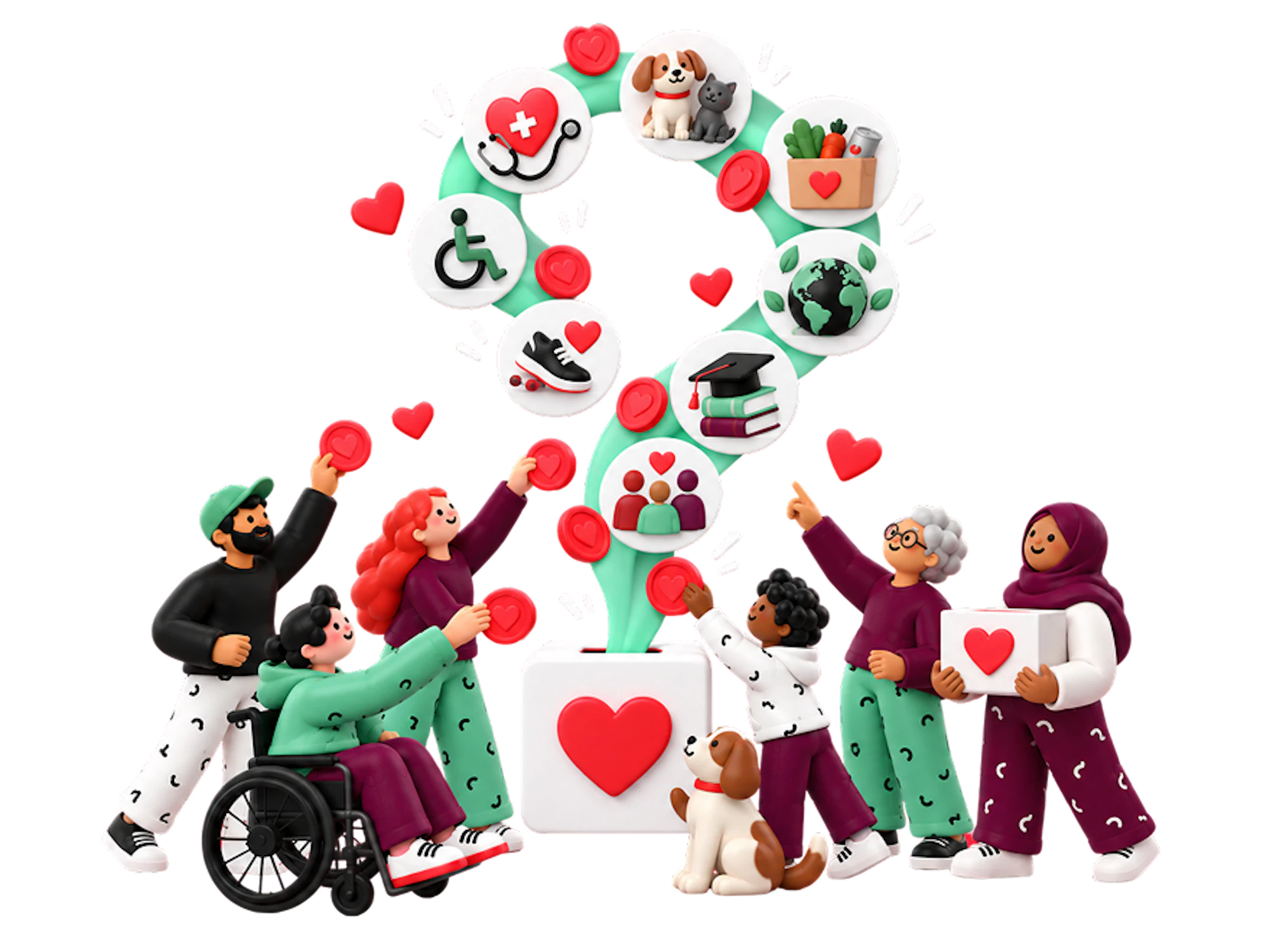

Fundraising has evolved. What was once driven by face-to-face appeals, direct mail, and one-off events has shifted into a digital-first experience shaped by platforms, data, and user behaviour. But while the tools have changed, human nature hasn’t. At its core, fundraising is still about one thing: understanding what motivates people to give, and what stops them.
For organisations and fundraisers alike, understanding these behaviours is key to improving results.
Today’s most effective fundraising platforms, like GoodHub, don’t just provide a place to collect donations. They are designed around behaviour insights that guide supporters from intention to action.
Because the reality is that many people want to give. They care about causes, feel empathy, and believe in making a difference. Yet there’s often a gap between intention and action. Closing that gap is where psychology plays a critical role.
From the way a story is told, to how progress is displayed, to how easy it is to donate in the moment, every element of a campaign influences behaviour. Subtle cues, like seeing others contribute or feeling emotionally connected, can increase engagement. On the other hand, friction, uncertainty, or lack of trust can quietly derail even the most worthy campaigns.
In this blog, we explore the key psychological principles behind successful fundraising campaigns, and how to apply them to create experiences that don’t just reach people but move them to act.
The motivation gap: Why people give (or don’t)
Most people care. They intend to donate. But intention alone isn’t enough.
This gap between wanting to give and actually taking action is one of the biggest challenges in fundraising.
Giving is driven by a mix of emotional, psychological, and practical factors. When these align, people are far more likely to follow through.
What motivates people to give:
- Emotional connection: People respond to causes that make them feel something.
- Perceived impact: Donors want to know their contribution matters.
- Personal identity: Giving often reflects values and beliefs.
- Sense of purpose: Supporting a cause can create meaning and a feeling of contributing to something bigger.
However, even when motivation exists, small barriers can interrupt action.
Why people don’t give:
- Lack of urgency: “I’ll do it later” often turns into not at all.
- Unclear messaging: If the ask or impact isn’t obvious, people hesitate.
- Perceived insignificance: If a donation feels too small to matter, motivation drops.
- Too much friction: Complicated forms, slow pages, or too many steps can stop action entirely.
Strong online fundraising platforms, like GoodHub, and campaigns are designed to bridge this gap by reinforcing intent and removing obstacles. That means making the impact clear, the ask compelling, and the path to donate as simple as possible. When done well, it turns passive support into meaningful action.

The power of storytelling and emotional triggers
Facts inform, but stories drive action.
A single, relatable story makes a cause feel more human and immediate, far more than statistics alone.
Why storytelling works:
- Emotional connection: Stories spark empathy and make the need feel real.
- Relatability: Donors can see themselves in the story.
- Memorability: Stories are easier to remember than facts.
- Clear impact: It’s easier to understand how a donation helps.
Strong fundraising stories don’t just create emotion; they guide action.
What effective stories include:
- A clear focus: A person or cause to connect with.
- A defined need: What’s at stake and why it matters now.
- A sense of hope: Showing that change is possible.
- A role for the donor: Making their impact clear.
When people feel something and understand their role, they are far more likely to give.

Goal setting and progress psychology
Clear goals don’t just guide a campaign; they shape behaviour.
A defined target answers two immediate questions for donors:
How much is needed? and How can I help?
Why goals matter:
- Clarity: A specific target makes the ask more concrete.
- Anchoring: Suggested amounts or totals influence how much people give.
- Momentum: Visible progress encourages continued participation.
- Shared purpose: Donors feel part of a collective effort.
Progress is equally powerful. As campaigns move closer to their goal, motivation increases.
How to use progress effectively:
- Show visible tracking: Progress bars or totals create a sense of movement, e.g., progress bars or totals.
- Celebrate milestones: Marking key points keeps energy high.
- Use stretch goals: Extending targets maintains momentum after the initial goal is reached.
- Reinforce impact: Link progress back to real-world outcomes.
Early momentum is critical. Campaigns that show activity from the start are far more likely to attract further support.

Social proof and network effects
People don’t give in isolation. They look to others for signals.
Seeing that others have donated reduces uncertainty and builds trust. It signals that a cause is credible and worth supporting.
It also creates momentum. People are naturally drawn to campaigns that feel active and growing, rather than static or unnoticed.
This effect becomes even stronger through personal networks. When someone shares or donates, it reaches people who already trust them, making engagement far more likely than a generic appeal.
For example, showing recent donations or supporter activity can reassure new visitors that a campaign is active and trusted.
Each action builds credibility, and that credibility drives further action. Over time, this creates a compounding effect where individual contributions turn into collective momentum.

Friction vs flow: The donor experience
At the point of donation, small details make a big difference.
The decision often comes down to a simple choice: continue or leave.
More often than not, drop-off isn’t about motivation; it’s about friction.
On fundraising platforms like GoodHub, these journeys are designed to remove unnecessary steps and simplify the giving experience.
Common sources of friction include:
- Long or complex donation forms.
- Unclear messaging about impact or next steps.
- Slow or unresponsive pages.
- Too many choices at the point of giving.
- Lack of reassurance or trust signals.
Flow is the opposite, a smooth, intuitive experience where giving feels effortless. When flow is achieved, donors don’t overthink the process; they simply move through it.
What creates flow:
- Simple, streamlined donation journeys.
- Clear and consistent messaging.
- Fast, mobile-friendly design.
- Transparent confirmation and outcomes.
- Minimal steps to complete a donation.
Ultimately, reducing friction and creating flow turns intent into action by removing anything that gets in the way at the moment of decision.
Turn empathy into action
Build campaigns on GoodHub that are designed around real human behaviour, so every moment of intention becomes a simple, powerful act of giving.
The future of fundraising is behaviour-driven
Understanding behaviour is only useful if it’s applied.
The most effective fundraising campaigns are not just well-intentioned; they are intentionally designed around how people think, feel, and act.
Key takeaways for stronger fundraising campaigns:
- Make the impact clear within seconds.
- Focus on one strong, human story.
- Set a specific, visible goal.
- Build early momentum to encourage others.
- Use social proof to reinforce trust.
- Remove friction from the donation journey.
When these elements come together, the gap between intention and action becomes much smaller, and giving becomes easier, faster, and more meaningful.
Start your campaign with GoodHub today and build fundraising experiences that turn intention into action.


Put your reason into action
Start fundraising for what matters to you, with expert support along the way.